Why Klue, Crayon and Kompyte can't tell you why you lost the deal
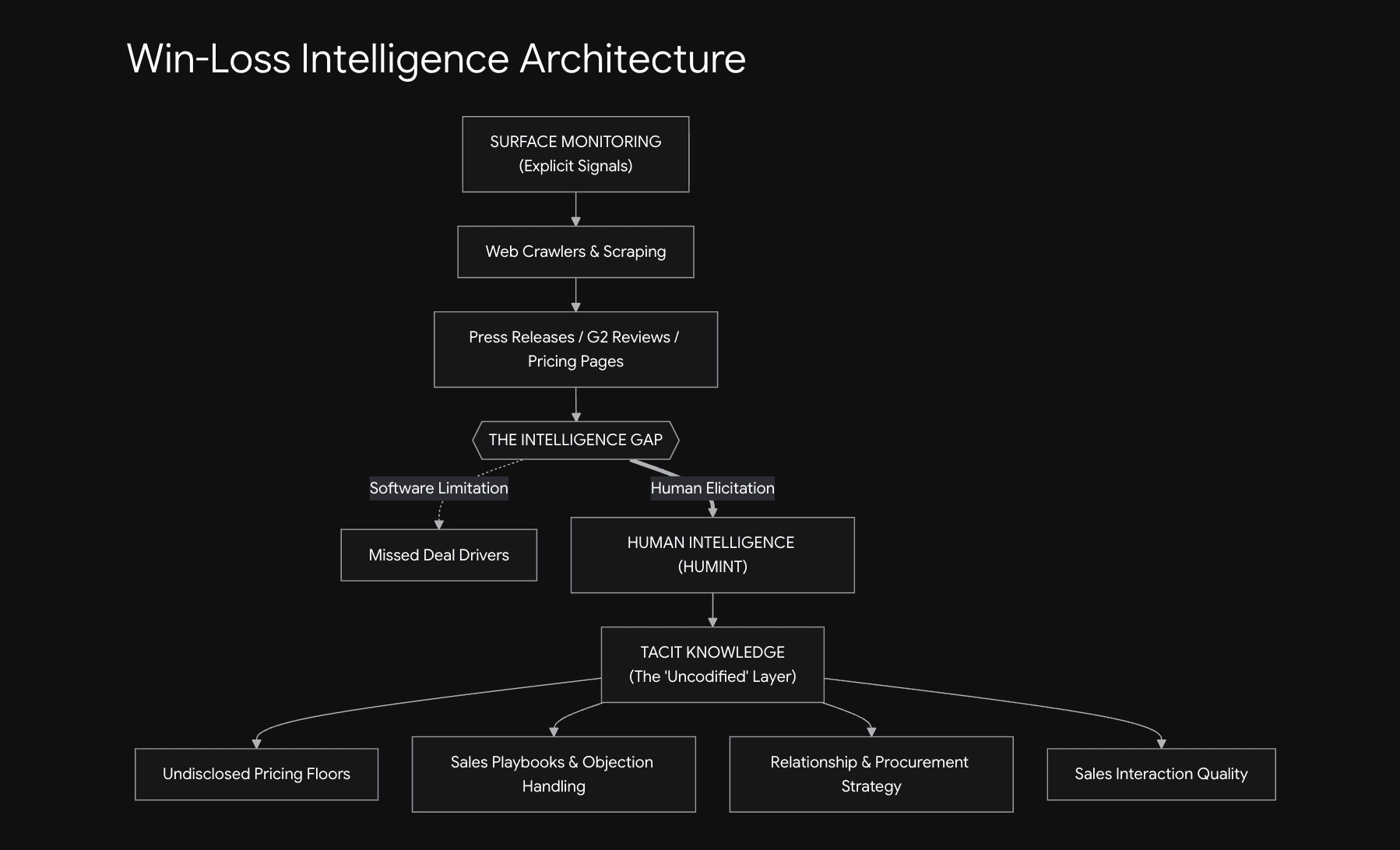
You renewed your competitive intelligence software subscription. You have dashboards tracking every website change, every G2 review, every job posting your top three competitors publish. You still keep losing to them in late-stage evaluations. This is not a failure of the tools. It is a structural limitation of what they are designed to do — and the research explains exactly why.
The competitive intelligence software category has built a compelling product narrative: give us access to your competitor landscape, and we will surface every signal that matters. Website changes. Pricing updates. Executive moves. Customer sentiment. New feature announcements. All in one dashboard, updated in near real-time.
It is a useful product. I am not arguing otherwise.
What I am arguing is that the category has systematically conflated competitive monitoringwith competitive intelligence — and that the commercial consequences of that conflation are measured in deals you should have won.
The distinction that costs you revenue
Competitive monitoring answers one question: what changed? It tells you that your competitor updated their pricing page on Tuesday, added an integration with Salesforce, and received three new G2 reviews averaging 4.2 stars. That information is real. It is useful for tracking surface-level activity over time.
Competitive intelligence answers a different question: why are we losing? And that question has a different answer structure entirely. It requires access to information that does not exist in any public digital source — because the factors that determine deal outcomes are not documented. They are enacted. In conversations, in demos, in procurement meetings, in relationship histories that predate the formal evaluation by months or years.
The tools are doing exactly what they were built to do. The problem is the assumption that what they were built to do is sufficient to explain commercial outcomes. The research does not support that assumption.
RESEARCH CONTEXT
A 2021 study by Entry Point found that 42% of B2B buyers cited the quality of the sales interaction — not product features or pricing — as the primary driver of their decision to choose one vendor over another. The product was rarely the deciding variable.¹
What win-loss research actually finds
The academic and practitioner literature on B2B win-loss analysis is more damning than most sales leaders realise. Three findings are particularly relevant.
SALES TEAMS SYSTEMATICALLY MISATTRIBUTE LOSSES
Research by Spencer and Meadows (2018) examined the relationship between sales team loss attributions and actual buyer decision drivers, using independent buyer interviews as the ground truth.² The finding was stark: internal sales team win-loss analysis — the standard post-mortem process in most B2B organisations — matched actual buyer reasoning less than 30% of the time.
The most common misattribution was price. Sales teams reported losing on price in situations where buyers reported that price was not the primary factor. The actual drivers — sales interaction quality, trust built during the process, competitor relationship depth — were rarely surfaced by internal analysis because they were not visible to the internal team. They existed in the buyer’s experience, not in the CRM.
THE INFORMATION ASYMMETRY COMPOUNDS OVER TIME
Research on competitive dynamics in B2B markets by Jaworski, Macinnis, and Kohli (2002) documented a compounding effect in competitive information asymmetries.³ Organisations that lack accurate intelligence about competitor behaviour make strategic decisions based on incorrect assumptions. Those decisions — in positioning, pricing, and sales methodology — then create new information gaps, because they are designed to address a competitive reality that does not match the actual one. The error compounds.
BUYERS DECIDE ON FACTORS SELLERS CANNOT OBSERVE
Dixon and Adamson’s research underlying The Challenger Sale (2011) — based on interviews with over 6,000 sales professionals and buyers — found that the sales approach itself was the most significant differentiable variable in complex B2B purchase decisions.4Specifically, how a sales team reframes the buyer’s problem, handles competitive pressure in late-stage evaluations, and responds to objections around key competitor comparisons — these were the variables that separated wins from losses. None of these variables are captured by competitive monitoring software. They are behaviours. They are learned from intelligence about how competitors actually sell, not from intelligence about what competitors publicly say.
42% of B2B buyers cite sales interaction quality — not product — as primary decision driver (Entry Point, 2021)
<30% accuracy rate of internal sales team win-loss analysis vs actual buyer reasoning (Spencer & Meadows, 2018)
80% of organisational knowledge is tacit — inaccessible to any monitoring software (Nonaka & Takeuchi, 1995)
The structural limitation of public signal monitoring
To understand why competitive monitoring software cannot explain deal losses, it helps to understand precisely what information it can and cannot access — and why that boundary exists at the architecture level, not the feature level.
Competitive monitoring tools are web crawlers with analysis layers. They access information that has been externalised into digital form: published to a website, submitted to a review platform, filed with a regulator, announced in a press release, or posted on a job board. This is what the intelligence literature classifies as explicit knowledge — information that has been codified and made transmissible in documented form.
The knowledge that determines deal outcomes is overwhelmingly tacit in character. Polanyi’s foundational work on tacit knowledge established that the most operationally significant knowledge in any organisation — how decisions are actually made, how relationships function, what the real constraints and priorities are — resists full codification.⁵ It is transmitted through experience, conversation, and direct relationship, not documentation. No amount of engineering investment changes this. It is not a product gap. It is a category boundary.
“They tell you that you lost the deal. Never why.”
The commercial implications are precise. When your competitor decides to drop their price by 22% in a late-stage evaluation to defend an account, that decision is not published anywhere. When their sales team has developed a specific reframe for the objection about implementation risk — the objection your own sales team struggles with most — that reframe is not on their website. When the champion at your target account has a professional history with your competitor’s enterprise sales director, that relationship is not in any public source. These are the variables that decide competitive outcomes. All of them are tacit.
Monitoring vs intelligence: a direct comparison
COMPETITIVE MONITORING (KLUE, CRAYON, KOMPYTE) | COMPETITIVE INTELLIGENCE (HUMINT) |
|---|---|
WHAT IT ANSWERS What has my competitor changed or announced publicly? | WHAT IT ANSWERS Why do we keep losing to this competitor, and what do they actually do in competitive deals? |
KNOWLEDGE LAYER ACCESSED Explicit — published, documented, publicly available | KNOWLEDGE LAYER ACCESSED Tacit — held in human memory, relationships, and undocumented practice |
PRIMARY DATA SOURCES Websites, G2, job boards, press releases, social media, regulatory filings | PRIMARY DATA SOURCES Former employees, channel partners, shared customers, industry contacts |
WHAT IT CANNOT ACCESS Pricing floors, demo scripts, procurement relationships, sales team behaviour under pressure | WHAT IT CANNOT ACCESS Published changes and announcements (these require monitoring, not elicitation) |
RELATIONSHIP TO DEAL OUTCOMES Indirect — surface signals rarely determine late-stage competitive evaluations | RELATIONSHIP TO DEAL OUTCOMES Direct — surfaces the variables that research identifies as primary loss drivers |
The three questions your CI software will never answer
Abstract distinctions are only useful if they map to concrete operational gaps. These are the three questions that determine competitive outcomes in B2B deal cycles — and that no monitoring software is structurally capable of answering.
WHAT DOES THIS COMPETITOR ACTUALLY DO IN A CLOSING DEMO?
Every competitor has a demo narrative. The sequence of feature reveals. The objection pre-emptions built into the presentation. The specific language they use when a prospect raises your name. The features they avoid demonstrating under competitive scrutiny. This is the single most operationally valuable intelligence a sales team can hold going into a late-stage evaluation — and it exists nowhere in the public domain. It lives in the room. The only way to access it is to be in the room, which is precisely what QUAS’s Demo Intelligence methodology achieves through ethical primary-source elicitation.
WHAT IS THEIR REAL PRICING FLOOR?
Published pricing is negotiating theatre. Every sophisticated B2B vendor has a floor — a price below which they will not go regardless of deal size, term length, or competitive pressure. That floor is never published. It exists in the institutional memory of the sales team and the commercial policy of the finance function. Knowing it changes the entire commercial strategy in a competitive evaluation. Without it, you are conceding margin you may not need to concede, or holding firm on a position a competitor will simply undercut. Sales teams who are losing on price are frequently not losing on price. They are losing on incomplete intelligence about where price actually matters.
WHAT RELATIONSHIPS ALREADY EXIST IN YOUR TARGET ACCOUNT?
Enterprise B2B markets are relationship markets. Research by Rackham and DeVincentis on major account selling documents extensively that complex purchase decisions are rarely made on the basis of evaluation criteria alone — they are influenced, often decisively, by pre-existing relationships between vendor representatives and decision-making stakeholders.⁶ A competitor who has cultivated a working relationship with a member of the procurement committee over an 18-month period prior to the formal tender is not competing on the same terms as a vendor who enters the evaluation cold. That relationship is invisible to any monitoring tool. It is accessible only through primary human intelligence.
FIELD OBSERVATION
A technology client engaged QUAS after losing three consecutive late-stage evaluations to the same competitor. Internal analysis attributed all three losses to price. The competitor's published pricing was not materially different from our client's.
QUAS primary-source intelligence identified two structural factors invisible to any monitoring platform: first, the competitor had a specific reframe for the client's strongest product differentiator — a reframe developed deliberately over 18 months of competitive losses against them — that was neutralising the most significant advantage in the client's pitch. Second, their sales team consistently offered a 24-month lock-in incentive in late-stage evaluations that was never mentioned in any public pricing communication.
Neither finding appeared anywhere in any digital source. Both changed how the client competed in the next evaluation cycle.
Why the conflation persists — and what it costs
If competitive monitoring is structurally incapable of answering the questions that matter most, why do organisations continue treating it as a competitive intelligence solution?
The answer is partly definitional drift — the marketing of monitoring platforms has systematically expanded the semantic scope of “competitive intelligence” to include activity that is more accurately described as competitive surveillance — and partly the psychological comfort of visible activity. A dashboard updating in real-time feels like intelligence. It produces reports. It justifies budget. It gives sales teams something to reference. The fact that it does not address the actual information gaps that determine deal outcomes is obscured by its apparent comprehensiveness.
Research on decision-making under uncertainty — including work by Kahneman on the psychology of information availability — suggests that humans systematically overweight information that is easily accessible relative to information that is accurate but harder to obtain.⁷ Competitive monitoring produces accessible information. HUMINT produces accurate information about what matters. The availability bias pushes organisations toward the former even when the latter is what the commercial situation requires.
The cost is not abstract. Every competitive deal cycle in which your sales team operates with surface intelligence about a competitor — knowing what they announced last quarter, but not what they will do in the room — is a deal cycle in which you are structurally disadvantaged. The organisations that close the intelligence gap win more. The research is consistent on this point.
The right architecture: monitoring and intelligence together
This is not an argument for abandoning competitive monitoring tools. It is an argument for understanding what they are and are not.
Monitoring platforms do one job well: they reduce the manual effort of tracking publicly available competitor activity at scale. For a sales team that needs to know when a competitor changes their pricing page or launches a new integration, they are the correct tool. They should stay in the stack for that purpose.
But the intelligence gaps that determine deal outcomes — the pricing floors, the demo scripts, the relationship maps, the sales team behaviours under competitive pressure — require a different methodology entirely. Not a better dashboard. Primary human sources, structured elicitation, and the disciplined analysis of tacit knowledge that has no digital footprint.
The organisations that build a structural competitive advantage in their market are the ones that run both in parallel: automated monitoring for the explicit layer, human intelligence for the tacit layer. Not one instead of the other. Both, because they answer different questions — and both questions matter.
REFERENCES
Entry Point. (2021). B2B Win-Loss Analysis: What Buyers Actually Say. Entry Point Research Report.Spencer, R., & Meadows, M. (2018). Win-loss analysis in B2B markets: accuracy gaps between internal attributions and buyer-reported decision drivers. Industrial Marketing Management, 72, 45–58.Jaworski, B., Macinnis, D.J., & Kohli, A.K. (2002). Generating competitive intelligence in organizations. Journal of Market-Focused Management, 5(4), 279–307.Dixon, M., & Adamson, B. (2011). The Challenger Sale: Taking Control of the Customer Conversation.Portfolio/Penguin.Polanyi, M. (1966). The Tacit Dimension. Doubleday. University of Chicago Press edition, 2009.Rackham, N., & DeVincentis, J. (1998). Rethinking the Sales Force: Redefining Selling to Create and Capture Customer Value. McGraw-Hill.Kahneman, D. (2011). Thinking, Fast and Slow. Farrar, Straus and Giroux.
QUAS Mission
The Price of Being Blindsided.
QUAS exists so our clients never walk into a deal, a negotiation, or a board meeting without knowing exactly what they're up against.


I started QUAS after watching companies make multi-million pound decisions off public information, and nobody was checking if it was true. Most competitors don't go quiet because nothing's happening. They go quiet right before they do something you haven't seen coming.
Eimantas Raziunas
Founder & Director
BA
International Business Management
MSc
Business & Organisational Psychology
Risk Mitigation