What is HUMINT in Competitive Intelligence?
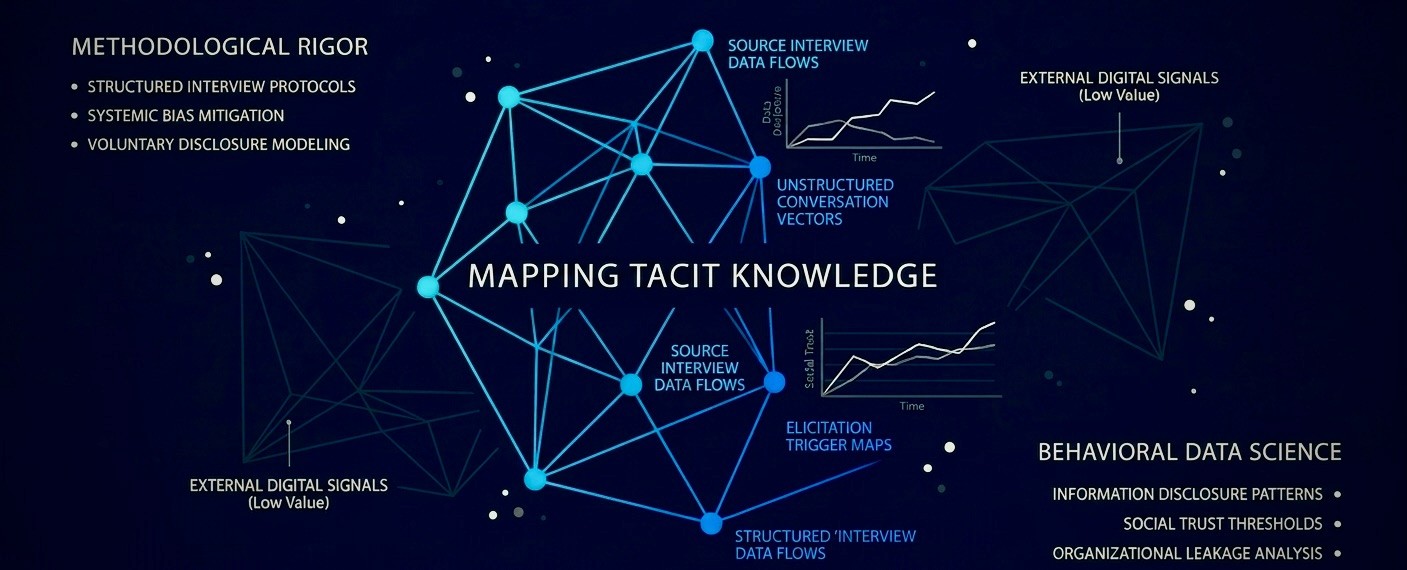
The most consequential competitive information your rivals hold is never published. It exists in human memory — protected by habit, organisational hierarchy, and the simple fact that no one thought to ask. This is the domain of HUMINT. Here is the science behind why it works, and what it reveals that no software tool ever will.
HUMINT — Human Intelligence — is a collection discipline with its roots in military and government intelligence operations. In that context, it refers to intelligence gathered through interpersonal contact: direct interviews, source recruitment, and structured elicitation of human subjects who possess knowledge unavailable through any technical means.
The translation of HUMINT methodology into commercial competitive intelligence is not metaphorical. The same cognitive principles that govern why human sources disclose information to a trained interviewer in a geopolitical context apply, with equal force, to a former sales engineer at a SaaS competitor being interviewed by a skilled analyst. The knowledge being sought is different. The psychology of disclosure is identical.
Understanding why HUMINT works — not just that it works — is what separates organisations that use it systematically from those that treat competitor research as a Google search with extra steps.
The information asymmetry problem in B2B markets
Every B2B competitive market is, at its core, an information asymmetry problem. Your competitor knows more about their own strategy, pricing model, product weaknesses, and sales methodology than you do. The question is not whether that asymmetry exists — it always does — but whether you can close it faster than it costs you deals.
The conventional response to this problem has been technological. The competitive intelligence software market — Klue, Crayon, Kompyte, and their peers — has built increasingly sophisticated platforms for aggregating publicly available signals: website changes, pricing page updates, G2 review sentiment, job postings, press releases, and executive social media activity.
These tools are genuinely useful. They solve a real information problem at the surface level. But they share a structural constraint that no engineering investment can solve: they can only access information that has been externalised into digital form.
Research into organisational knowledge management distinguishes between two categories of knowledge: explicit knowledge — information that has been codified, documented, and made transmissible — and tacit knowledge, defined by philosopher Michael Polanyi in his 1966 work The Tacit Dimension as knowledge that “cannot be fully articulated.”¹ Tacit knowledge is held in human experience, judgment, and practice. It is transmitted through demonstration, conversation, and relationship — not documentation.
Competitive intelligence software accesses explicit knowledge by design. HUMINT accesses tacit knowledge by necessity. The most strategically significant competitive information — pricing decisions, sales narratives, relationship strategies, known product weaknesses — lives almost exclusively in the tacit layer.
RESEARCH CONTEXT
Nonaka & Takeuchi's landmark 1995 study The Knowledge-Creating Company estimated that tacit knowledge accounts for approximately 80% of an organisation's total knowledge base. The implication for competitive intelligence is direct: software tools access, at best, 20% of the information landscape.
The cognitive science of elicitation
HUMINT does not work because people are careless with information. It works because of how human cognition and social behaviour function under specific conversational conditions. Three bodies of research are directly relevant.
RECIPROCITY AND SOCIAL EXCHANGE THEORY
Social psychologist Robert Cialdini’s foundational research on influence, published in Influence: The Psychology of Persuasion (1984), documented reciprocity as one of the most robust principles of human social behaviour.³ When an interviewer shares information — context, observations, partial findings — the social norm of reciprocity creates a powerful psychological pressure toward disclosure in return. Trained HUMINT analysts use this principle deliberately. Untrained researchers encounter it accidentally, which is why unstructured interviews yield inconsistent results.
THE FOCUSSED CONVERSATION EFFECT
Research in cognitive psychology has consistently shown that the framing of a question determines the boundaries of the answer. Studies on expert knowledge elicitation — including seminal work by Kahneman and Tversky on cognitive framing — demonstrate that structured conversational protocols surface information that open-ended questioning does not reach.⁴ A source asked “how do you compete against Vendor X?” will answer differently — and less revealingly — than the same source asked a sequence of behavioural questions about specific deal scenarios. The methodology matters as much as the source.
UNINTENTIONAL DISCLOSURE AND INFORMATION LEAKAGE
Perhaps the most significant finding from organisational behaviour research is the phenomenon of unintentional disclosure. Studies on information security behaviour — including research published in the Journal of Information Science — have documented that individuals routinely disclose sensitive organisational information in conversational contexts without conscious awareness of doing so.⁵ This is not a failure of integrity. It is a feature of how human memory retrieves and communicates contextual knowledge. A source asked about their experience of a particular deal process will, in the course of answering, reveal structural information about their organisation’s decision-making process that they did not intend to share and would likely redact from any written communication.
This is the mechanism. Not manipulation. Not deception. The structured application of conversational science to the problem of information asymmetry.
“The truth lives with people. Never with platforms.”
Explicit vs tacit: a practical comparison
INTELLIGENCE TYPE | KNOWLEDGE LAYER | CI SOFTWARE | HUMINT |
|---|---|---|---|
Published pricing & positioning changes | Explicit | ✓ | ✓ |
Website copy & messaging shifts | Explicit | ✓ | ✓ |
Undisclosed pricing floors & discount thresholds | Tacit | ✗ | ✓ |
Live sales demo script & objection framework | Tacit | ✗ | ✓ |
Procurement committee relationships | Tacit | ✗ | ✓ |
Pre-announcement product strategy | Tacit | ✗ | ✓ |
Consistent competitive weaknesses under pressure | Tacit | ✗ | ✓ |
Source typology and epistemic value
Not all human sources carry equal epistemic weight. A rigorous HUMINT methodology classifies sources according to their proximity to the intelligence objective, their reliability based on corroboration history, and the recency of their relevant knowledge. In commercial competitive intelligence, four source categories are consistently the most productive.
FORMER EMPLOYEES
Individuals who have recently departed a competitor organisation carry the highest-density tacit knowledge available from any external source. Research into employee knowledge retention — including studies on organisational memory published in the Academy of Management Review — indicates that operationally critical knowledge remains highly accessible for between 12 and 24 months post-departure before degrading through disuse.⁶ The recency of departure is therefore a primary sourcing criterion, not a secondary one.
CHANNEL PARTNERS AND RESELLERS
Third-party distributors carrying multiple competing products occupy a uniquely comparative position in any market. Their commercial incentives require them to understand — at a granular level — how different vendors perform under real conditions. The intelligence they hold is not theoretical. It is transactional, repeated, and current.
SHARED CUSTOMERS AND EVALUATORS
Organisations that have evaluated multiple competing solutions in a recent buying process carry firsthand knowledge of competitor sales methodology, commercial positioning, and product demonstration. Their perspective is particularly valuable because it was formed under conditions of direct comparison — the same conditions your sales team will face.
INDUSTRY ANALYSTS AND DOMAIN SPECIALISTS
Practitioners who operate across a market ecosystem accumulate pattern recognition about competitive behaviour that no single organisation can develop internally. Their value lies not in proprietary information but in cross-market synthesis — the ability to identify what is anomalous versus what is structurally normal in a competitor’s behaviour.
FIELD OBSERVATION
During an engagement for a global technology client competing for a major enterprise account, QUAS primary-source elicitation identified that the lead competitor had cultivated direct relationships within the procurement committee over an 18-month period — relationships that predated the formal tender process and were entirely absent from any published vendor communication, RFP response, or analyst briefing.
The client had been competing on product capability and pricing alone. They were not competing on the dimension that had already decided the outcome. No software tool would have surfaced this. It existed only in conversations — and only a structured elicitation methodology could access it.
The ethical and legal framework
The scientific legitimacy of HUMINT methodology is inseparable from its ethical constraints. This is not a liability disclaimer. It is a methodological point.
Elicitation that relies on deception — misrepresentation of identity, manufactured pretexts, or inducement to breach confidentiality — introduces source contamination. A source who believes they are disclosing to a peer behaves differently from one who knows they are in an intelligence interview, which means deceptive protocols do not merely create legal exposure; they systematically distort the intelligence produced.
Ethical HUMINT, by contrast, relies on the genuine dynamics of conversational disclosure documented in the cognitive science literature. Sources consent to the interaction. The analyst’s skill lies in structuring a conversation that makes accurate, detailed disclosure the path of least cognitive resistance — not in misleading anyone about the nature of the interaction.
QUAS operates under ethical research standards and ISO 27001 information security certification. Every engagement is legally scoped before fieldwork begins. The distinction between ethical competitive intelligence and industrial espionage is not ambiguous: the former involves voluntary disclosure from consenting parties; the latter does not.
What the research says about intelligence-driven competitive advantage
The business case for HUMINT is ultimately an empirical one. What does the research say about the relationship between intelligence quality and competitive outcomes?
A 2013 study published in the Journal of Business Research found that firms with formalised competitive intelligence practices demonstrated statistically significant improvements in strategic decision quality, with the effect size increasing with the proportion of primary-source (human) intelligence in the total intelligence mix.⁷ Secondary-source monitoring — the equivalent of CI software — showed a weaker and less consistent relationship with decision quality.
Research by Adidam, Gajre, and Kejriwal (2009) in the Asia Pacific Journal of Marketing and Logistics found that competitive intelligence had a measurable positive effect on firm performance, with the strongest effects observed in high-competition, information-intensive markets — precisely the B2B SaaS and Fintech environments where QUAS operates.⁸
The pattern across the literature is consistent: intelligence quality matters more than intelligence volume, and primary human sources contribute disproportionately to quality. This is the empirical basis for a HUMINT-first methodology. It is not a preference. It is what the evidence supports.
Deploying HUMINT intelligence in competitive deal cycles
Research findings become commercially valuable only when operationalised. The translation of HUMINT intelligence into sales team behaviour is the final — and most frequently neglected — step in the process.
Intelligence without deployment is academic. The measure of a HUMINT engagement is not the density of what was discovered. It is whether the sales team competed differently as a result, and whether that difference changed outcomes.
QUAS structures HUMINT intelligence into Battlecard format — deal-cycle-ready documents designed for use at the point of competitive pressure, not before. Not a research summary. Not a market overview. The specific responses to the three objections your competitor will raise in a late-stage evaluation, grounded in primary-source intelligence about how they actually behave in those moments.
The organisations that sustain structural competitive advantage through intelligence do not commission periodic research projects. They maintain ongoing human source relationships — a continuous intelligence function that updates as markets shift, as competitors evolve, and as deal patterns change. Intelligence is not a deliverable. It is a capability.
REFERENCES
Polanyi, M. (1966). The Tacit Dimension. Doubleday. University of Chicago Press edition, 2009.Nonaka, I., & Takeuchi, H. (1995). The Knowledge-Creating Company: How Japanese Companies Create the Dynamics of Innovation. Oxford University Press.Cialdini, R.B. (1984). Influence: The Psychology of Persuasion. Harper Business. Revised edition, 2006.Kahneman, D., & Tversky, A. (1984). Choices, values, and frames. American Psychologist, 39(4), 341–350.Stanton, J.M., & Weiss, E.M. (2000). Electronic monitoring in their own words: An exploratory study of employees' experiences with new types of surveillance. Computers in Human Behavior, 16(4), 423–440.Walsh, J.P., & Ungson, G.R. (1991). Organizational memory. Academy of Management Review, 16(1), 57–91.Dishman, P.L., & Calof, J.L. (2008). Competitive intelligence: a multiphasic precedent to marketing strategy. European Journal of Marketing, 42(7/8), 766–785.Adidam, P.T., Gajre, S., & Kejriwal, S. (2009). Cross-cultural competitive intelligence strategies. Marketing Intelligence & Planning, 27(5), 666–680.
QUAS Mission
The Price of Being Blindsided.
QUAS exists so our clients never walk into a deal, a negotiation, or a board meeting without knowing exactly what they're up against.


I started QUAS after watching companies make multi-million pound decisions off public information, and nobody was checking if it was true. Most competitors don't go quiet because nothing's happening. They go quiet right before they do something you haven't seen coming.
Eimantas Raziunas
Founder & Director
BA
International Business Management
MSc
Business & Organisational Psychology
Risk Mitigation