Why it's better to hire outside analysts for competitive intelligence needs
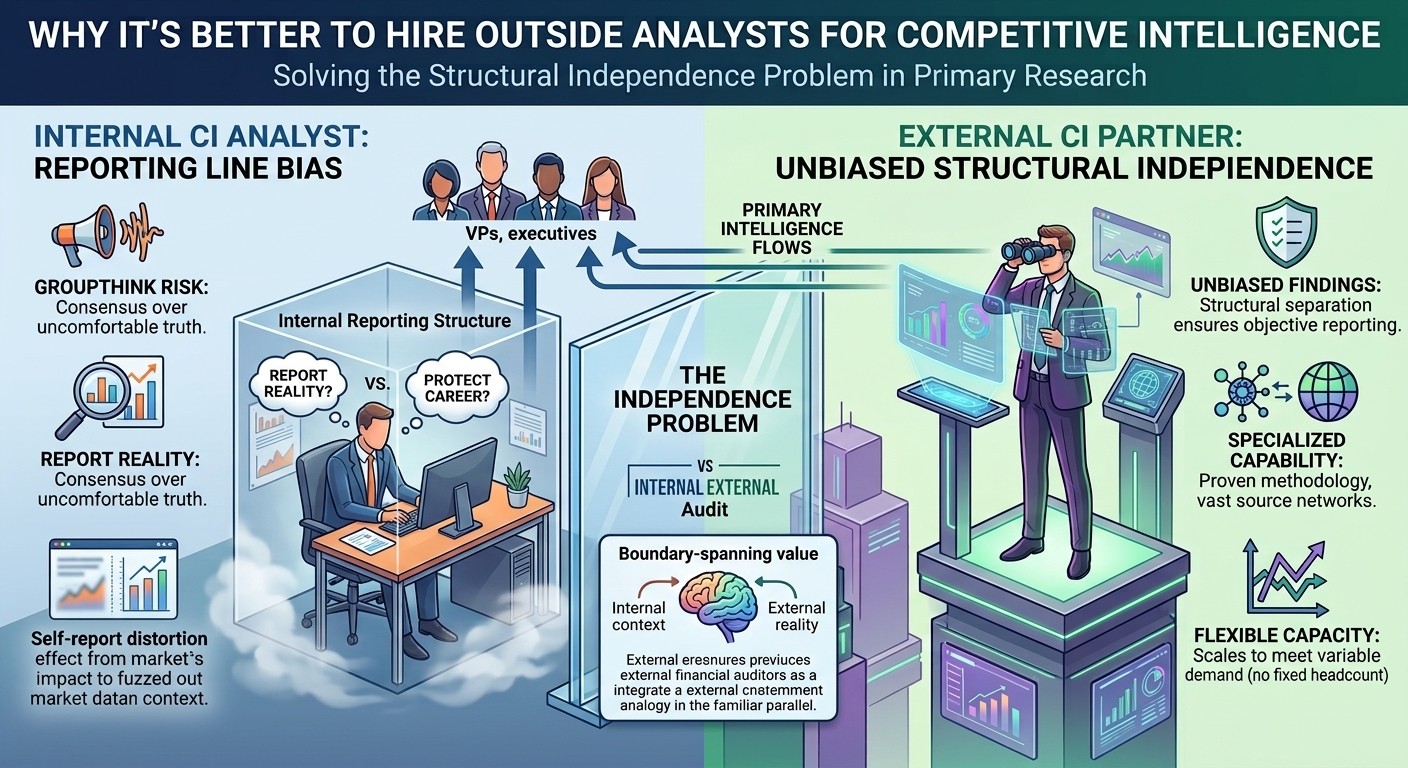
An internal competitive intelligence analyst reports to the same leadership team they are analysing competitors for. That is not a minor organisational detail. It is a structural independence problem with decades of research behind it — and it is the single strongest argument for sourcing primary intelligence from outside the organisation.
When an organisation decides to formalise competitive intelligence, the instinctive move is often to hire for it — add a headcount, give someone the title, fold it into an existing team. This article makes the case that, for the specific function of primary intelligence gathering, this instinct is usually wrong, and the reason is not cost or convenience. It is a structural independence problem that no amount of internal talent fully resolves.
The independence problem
An internal analyst sits inside the same reporting line, the same social fabric, and the same incentive structure as the people they are informing. When their findings confirm what leadership already believes, there is no friction. When their findings contradict it — when the data suggests the team is losing for reasons nobody wants to hear — the internal analyst faces a choice an external one simply does not.
This is not a hypothetical concern. It is the organisational-behaviour equivalent of the self-report distortion examined elsewhere in this series. A sales rep completing a CRM field protects their own self-concept by externalising the cause of a loss, as Leon Festinger's cognitive dissonance research predicts. An internal CI analyst, delivering a finding to the same leadership team that controls their role, budget, and career progression, faces a structurally similar pressure — except here the dissonance being avoided is not personal failure, but organisational conflict.
RESEARCH CONTEXT
Irving Janis's foundational 1972 work on groupthink documented how cohesive groups systematically suppress dissenting information to preserve consensus and avoid interpersonal friction.¹ An internal analyst, embedded socially and organisationally within the team receiving their findings, is structurally positioned to experience exactly this pressure — particularly when a finding would mean telling a VP Sales that the team's own process, not the competitor's product, is the reason deals are being lost.
This is precisely the reasoning behind external financial audit. No serious organisation would accept its own finance team, reporting to the CFO, as a fully independent check on the CFO's own numbers — which is why independent external auditors exist as a distinct, structurally separate function, not an internal one. Competitive intelligence has the identical independence problem. It simply lacks the equivalent institutional expectation that the function should sit outside the reporting line it evaluates.
Boundary-spanning value: why distance is the point, not a limitation
Organisational behaviour research on boundary-spanning roles — functions that sit at the edge of an organisation and bring in information from outside it — offers a useful frame for what competitive intelligence actually is. Michael Tushman's 1977 study of boundary roles in the innovation process found that individuals who maintained genuine distance from an organisation's internal assumptions were more effective at bringing in information that challenged those assumptions, precisely because they had less personal stake in the organisation's existing beliefs being correct.²
Competitive intelligence is, by definition, a boundary-spanning function — its entire purpose is to bring external reality into an internal decision-making process. An analyst who becomes fully embedded inside the organisation they serve gradually loses some of the outside vantage point that made their findings valuable in the first place. This is not a criticism of internal analysts as individuals. It is a structural observation about what the role requires to do its job well, and what full organisational embeddedness tends to erode over time.
"An analyst who becomes fully embedded inside the organisation gradually loses the outside vantage point that made their findings valuable."
The capacity problem
Competitive intelligence demand is not steady. It spikes before a major competitive evaluation, a pricing committee review, or a board discussion about market entry, and goes quiet in between. A single internal headcount is sized for one of two states: underutilised during quiet periods, or overwhelmed exactly when the organisation needs intelligence fastest — immediately before a high-stakes deal, when there is no time to compensate for a bottleneck.
An external partner, by contrast, draws on a pool of specialist capacity that can flex to match genuinely variable demand, without the organisation carrying the fixed cost of headcount sized for its busiest quarter. This is a straightforward operational argument, but it compounds with the independence and specialisation points above rather than standing apart from them.
Specialisation economics: paying the learning curve once
Elsewhere in this series, Oliver Williamson's transaction cost framework was used to argue that highly specialised, infrequently needed capabilities are typically better sourced externally than built internally.³ Primary-source HUMINT elicitation is exactly this kind of capability — a skill that takes years of deliberate practice to develop competently, and ethically.
A single internal hire pays that multi-year learning curve alone, on one organisation's budget, developing relationships specific to that organisation's competitors from a standing start. A specialist external firm has typically paid an equivalent learning curve once, and amortised it across dozens of engagements and multiple client relationships — arriving at a given organisation's door with a trained methodology and, frequently, existing source relationships that already overlap with the competitors in question.
What this does not mean
None of this is an argument for discarding internal context. The analysis function — synthesising findings into a decision, understanding which intelligence actually matters to this organisation's specific strategy — benefits enormously from deep internal familiarity, and is a function this series has consistently recommended keeping in-house. The case here is narrower and more specific: primary intelligence gathering, the function most exposed to the independence problem and most dependent on years of specialised skill, is where external sourcing has the strongest structural justification.
WHERE INTERNAL CONTEXT STAYS VALUABLE
The independence case is about primary intelligence specifically, not every CI function
INTERNAL:Deciding what questions matter
Defining intelligence priorities against the organisation's actual strategy requires context an outsider cannot fully replicate without being told.
EXTERNAL:Gathering primary intelligence
The function most exposed to the independence problem, and most dependent on a specialised, multi-year skill set that is costly to build for one organisation alone.
INTERNAL:Day-to-day relationship with the sales team
Someone inside the organisation who sales reps know and trust remains valuable for day-to-day intake and dissemination, even when primary research is sourced externally.
EXTERNAL:Delivering findings leadership may not want to hear
An external analyst with no ongoing stake in internal politics is structurally better positioned to report an uncomfortable finding plainly.
Internal versus external: a direct comparison
DIMENSION | INTERNAL ANALYST | EXTERNAL ANALYST |
|---|---|---|
Independence from the findings' audience | Limited — reports to the leadership the findings concern | Structural — no ongoing employment relationship with internal stakeholders |
Capacity flexibility | Fixed to one headcount regardless of demand | Scales to variable, lumpy demand without fixed cost |
Specialisation depth | Learning curve paid alone, from a standing start | Learning curve amortised across many client engagements |
Source network | Built from zero, specific to one organisation's competitors | Often already exists, developed across prior engagements |
Internal strategic context | Deep and immediate | Requires deliberate briefing and onboarding |
A PATTERN ACROSS ENGAGEMENTS
A pattern recurs across organisations that have tried the fully internal route first: the findings that eventually prove most consequential — the ones that change a pricing strategy or a go-to-market plan — are disproportionately the ones an internal analyst would have had the hardest time delivering, precisely because they contradicted what leadership already believed.
The independence that makes an external analyst's findings harder to dismiss is not a limitation of the arrangement. It is the arrangement's entire point.
REFERENCES
Janis, I.L. (1972). Victims of Groupthink: A Psychological Study of Foreign-Policy Decisions and Fiascoes. Houghton Mifflin.Tushman, M.L. (1977). Special boundary roles in the innovation process. Administrative Science Quarterly, 22(4), 587–605.Williamson, O.E. (1975). Markets and Hierarchies: Analysis and Antitrust Implications. Free Press. See also: Williamson, O.E. (1985). The Economic Institutions of Capitalism. Free Press.
QUAS Mission
The Price of Being Blindsided.
QUAS exists so our clients never walk into a deal, a negotiation, or a board meeting without knowing exactly what they're up against.


I started QUAS after watching companies make multi-million pound decisions off public information, and nobody was checking if it was true. Most competitors don't go quiet because nothing's happening. They go quiet right before they do something you haven't seen coming.
Eimantas Raziunas
Founder & Director
BA
International Business Management
MSc
Business & Organisational Psychology
Risk Mitigation