How to choose competitive intelligence consulting for B2B SaaS
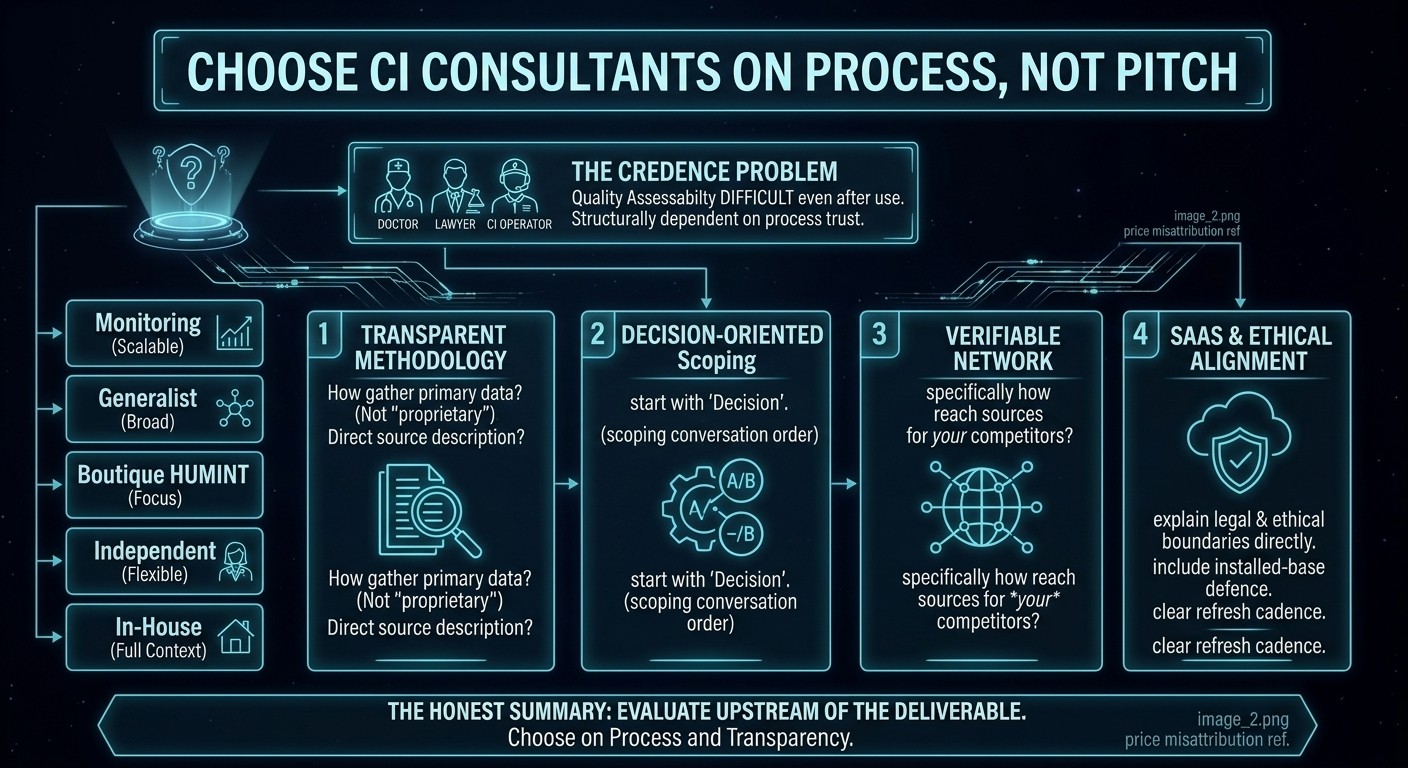
Choosing a competitive intelligence partner is harder than choosing almost any other professional service a SaaS company buys — because you often cannot verify whether the work was any good, even after you have paid for it and acted on it. There is a precise economic reason for that difficulty, a crowded and increasingly confusing vendor landscape sitting on top of it, and a framework that actually helps.
Compare buying a laptop with hiring a competitive intelligence consultant, and the difference in difficulty is stark. A laptop's specifications — processor, memory, screen resolution — can be compared line by line before any money changes hands. A restaurant's quality becomes apparent within the first course. A competitive intelligence engagement is neither. You can read the final report, act on its recommendations, and still have no reliable way to know whether it was accurate, complete, or worth what you paid — because checking would require the same specialised access the consultant was hired to provide in the first place.
This is not a minor inconvenience. It is the central reason vendor selection in this category is so often done badly — on the basis of a polished pitch deck, a familiar brand name, or simply whoever responded fastest to an inbound enquiry. A structured evaluation approach matters more here than in almost any other professional services purchase a SaaS company makes.
Why this category is uniquely hard to buy correctly
Economists studying information problems in markets distinguish between three categories of goods, based on when — if ever — a buyer can actually assess quality. Phillip Nelson's foundational 1970 work established the first two: search goods, whose quality can be determined by inspection before purchase, and experience goods, whose quality only becomes apparent through use.¹ Michael Darby and Edi Karni's 1973 extension of this framework identified a third, more troubling category: credence goods, whose quality is difficult to assess even after consumption, because doing so would require expertise or access the buyer does not possess.²
SEARCH GOOD | EXPERIENCE GOOD | CREDENCE GOOD |
|---|---|---|
Quality assessable before purchase, by direct comparison of specifications | Quality assessable after use, through direct experience of the outcome | Quality remains difficult to verify even after the service has been delivered and used |
Legal advice, medical diagnosis, and car repair are the classic examples in the economics literature — in each case the buyer typically lacks the expertise to independently confirm whether the service they received was necessary, complete, or correctly executed. Competitive intelligence sits squarely in this category. A battlecard claiming a specific pricing floor, or a specific competitor weakness, cannot be independently verified by the buyer without the same primary-source access the consultant was hired to provide. The buyer is, structurally, dependent on trusting the process that produced the conclusion, because the conclusion itself resists independent verification.
"The buyer is structurally dependent on trusting the process — because the conclusion itself resists independent verification."
The CI consulting landscape for B2B SaaS
The market a SaaS buyer is choosing from today spans five distinct provider categories, each with a different risk profile precisely because of the credence-good problem above — the harder a category's output is to verify, the more the selection process itself has to compensate.
CATEGORY | STRENGTH | LIMITATION |
|---|---|---|
Monitoring software (Klue, Crayon, Kompyte) | Continuous, scalable coverage of public signals; output is directly checkable against the source | Cannot access the tacit knowledge layer — pricing floors, demo scripts, internal strategy — examined throughout this series |
Generalist market research or strategy consultancies | Broad analytical capability, established brand credibility | Rarely specialise in primary-source HUMINT elicitation specifically; often slower and priced for enterprise engagements |
Boutique HUMINT-specialist CI firms | Deep, narrow expertise in primary source elicitation and analysis; typically faster and more focused | Quality varies significantly between providers, and the credence-good problem applies most acutely here |
Independent freelance analysts | Lower cost, high flexibility | Single point of failure, harder to verify credentials or track record, no institutional quality process |
Building in-house | Full organisational context, no external dependency | HUMINT capability specifically takes years to build; examined in detail elsewhere in this series |
Most mature SaaS organisations end up combining categories rather than relying on one: monitoring software for continuous surface-level coverage, paired with a specialist partner for the primary intelligence layer that software cannot reach — the build-versus-buy logic examined at length elsewhere in this series.
What has shifted in the market
Three directional changes are worth noting for a buyer evaluating this market now, without overstating any of them into a hard prediction. Monitoring capability at the software layer has become increasingly commoditised — AI-assisted signal detection is now a baseline expectation across most platforms in this category rather than a differentiator, which means the layer that used to distinguish vendors from each other has largely stopped doing so. Buyer sophistication about the distinction between monitoring and primary intelligence has increased meaningfully, as more organisations have run into the specific ceiling examined throughout this series — knowing everything a competitor publishes while remaining unable to explain why deals are actually lost. And budget scrutiny across SaaS organisations has tightened in the current environment, which means competitive intelligence spend increasingly has to be justified against a specific decision it informed, not treated as a standing line item nobody revisits.
RESEARCH CONTEXT
None of these shifts resolve the underlying credence-good problem — they arguably sharpen it. A more sophisticated buyer, facing more vendors making similar claims about primary-source capability, still cannot directly verify which claims are accurate without the evaluation discipline set out below.
An evaluation framework that actually predicts quality
Because the finished deliverable resists direct verification, the evaluation has to focus on process signals that correlate with quality rather than the deliverable itself. Parasuraman, Zeithaml, and Berry's SERVQUAL framework, developed to measure quality across professional services generally, identifies transparency of process as one of the primary dimensions buyers can actually assess before an engagement concludes — and it is the dimension this framework leans on most heavily.³
THE CI CONSULTING EVALUATION FRAMEWORK
Process signals that correlate with output quality
Methodology transparency
Can they describe precisely how they gather primary intelligence — source categories, elicitation approach, corroboration process — rather than describing it only as "proprietary"?
CORE SIGNAL
Decision orientation in scoping
Does the first scoping conversation ask what decision you're trying to make, before asking which competitor you want researched? The order reveals whether they operate with an intelligence mindset or a research mindset.
CORE SIGNAL
Willingness to push back on scope
A vendor who accepts any brief without narrowing it is not doing their job. Genuine expertise includes challenging an under-specified or over-broad request before agreeing to it.
CORE SIGNAL
Evidence of an active source network
Methodology documentation without demonstrated source access produces elegant plans that cannot be executed. Ask specifically how they would identify and reach sources for your named competitors.
CORE SIGNAL
Comfort discussing legal and ethical boundaries directly
A vendor confident in their methodology should be able to explain, without hesitation, exactly where the ethical and legal line sits in their research process — vagueness here is a warning sign, not caution.
CORE SIGNAL
SaaS-specific fluency
For a SaaS buyer specifically: do they have a clear answer on refresh cadence given fast release cycles, and does their scope include installed-base defence intelligence alongside new-logo battlecards, or only the latter?
SAAS-SPECIFIC
Red flags worth treating seriously
⚑ "Proprietary process" as the entire methodology answer
A confident, credible provider can explain their approach in specific terms without disclosing trade secrets. Total opacity is a substitute for substance, not a sign of sophistication.
⚑ Accepting "tell us everything about our competitors" without narrowing it
An open-ended brief produces comprehensive research, not targeted intelligence. A vendor who doesn't push back on this is signalling they'll deliver whatever's easiest, not whatever's useful.
⚑ Discomfort naming legal or ethical boundaries directly
This is the opposite of what confidence looks like. A provider who hedges or changes the subject when asked how they stay within ethical and legal limits is a risk to your organisation, not just a quality concern.
⚑ Deliverables indistinguishable from a monitoring software export
If the "intelligence" you receive could have been produced by a Klue or Crayon subscription, you have paid consulting rates for a research summary, not primary intelligence.
A structured decision process
Shortlist three providers across at least two categories
Don't compare only boutique firms against each other, or only software platforms — compare across the taxonomy above to understand what each type genuinely offers.
Run the same structured scoping conversation with each
Use the six-question briefing framework examined elsewhere in this series consistently across every provider, so responses are genuinely comparable rather than shaped by however each conversation happened to unfold.
Request a sample deliverable before committing
A provider confident in their methodology should be willing to show a redacted example of their actual output format, not just describe it in a pitch.
Price against the decision, not the deliverable
Anchor the cost conversation to the commercial value of the decision the intelligence will inform, rather than comparing headline day rates or package prices in isolation.
Start with the smallest engagement that tests the relationship
Given the credence-good problem, a single, focused first engagement — one competitor, one clearly defined decision — lets you assess process quality directly before committing to a larger retainer.
THE HONEST SUMMARY
You will not be able to fully verify the quality of competitive intelligence work by reading the finished report. That is not a flaw specific to any one provider — it is the nature of the category, shared with legal advice, medical diagnosis, and every other credence good economists have studied.
The evaluation has to happen upstream of the deliverable: in how a provider scopes the engagement, how transparently they describe their methodology, and how they behave when a brief is too broad or a boundary question gets asked directly. Choose on process, because the outcome alone will not tell you enough.
REFERENCES
Nelson, P. (1970). Information and consumer behavior. Journal of Political Economy, 78(2), 311–329.Darby, M.R., & Karni, E. (1973). Free competition and the optimal amount of fraud. Journal of Law and Economics, 16(1), 67–88.Parasuraman, A., Zeithaml, V.A., & Berry, L.L. (1988). SERVQUAL: A multiple-item scale for measuring consumer perceptions of service quality. Journal of Retailing, 64(1), 12–40.
QUAS Mission
The Price of Being Blindsided.
QUAS exists so our clients never walk into a deal, a negotiation, or a board meeting without knowing exactly what they're up against.


I started QUAS after watching companies make multi-million pound decisions off public information, and nobody was checking if it was true. Most competitors don't go quiet because nothing's happening. They go quiet right before they do something you haven't seen coming.
Eimantas Raziunas
Founder & Director
BA
International Business Management
MSc
Business & Organisational Psychology
Risk Mitigation