What is Demo Intelligence — and why your sales team needs it?
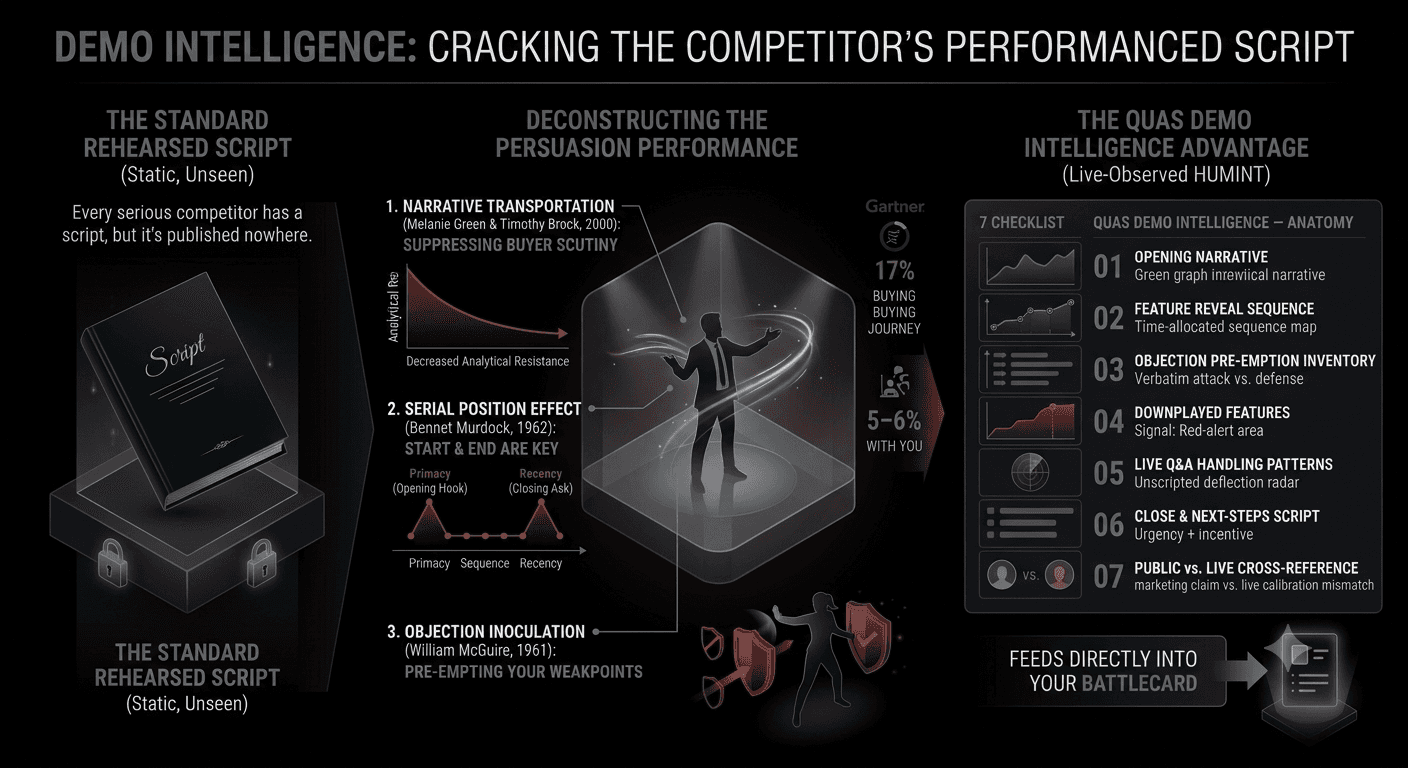
Every serious competitor has a demo script rehearsed until it sounds spontaneous. It is the single most persuasive document they produce — and the only one that exists nowhere in writing. Demo Intelligence is how you get inside it before your prospect does.
Ask a sales leader to name the single piece of competitor content they would most like to see before a final-round evaluation, and the answer is rarely a pricing sheet or a feature comparison. It is the demo. Specifically: what does the competitor's rep say, show, and skip when they are sitting across from a prospect who might choose us instead of them?
That document does not exist anywhere. Not on the competitor's website, not in their sales enablement portal, not in any analyst briefing. It is performed, not published — reconstructed slightly differently in every room, by a rep who has rehearsed it enough times that it no longer feels rehearsed. Demo Intelligence is the discipline of accessing that performance directly, and analysing it with the same rigour usually reserved for published research.
Why the demo outweighs almost everything else in the deal
The disproportionate importance of the demo is not a sales opinion. It follows from a simple, well-documented feature of B2B buying behaviour: buyers spend remarkably little of their total purchase journey in direct contact with any single vendor.
17% of the total B2B buying journey is spent meeting with any potential supplier at all
5–6%of that journey is spent with a single vendor's rep when multiple suppliers are being compared
When the total window of direct influence is this narrow, the interactions that do occur inside it carry disproportionate weight. The demo is typically the longest, most structured, and most memorable of those interactions — the one moment where a competitor controls the narrative, the pacing, and the framing in real time, in front of the exact people who will decide the deal.
Everything else — the website, the one-pager, the case study PDF — is a static artefact, finished once and shown to everyone identically. The demo is adaptive. It is built, consciously or not, using techniques from persuasion psychology that are considerably harder to detect from a transcript than from watching them unfold live.
The psychological architecture of a sales demo
A well-run competitive demo is not a neutral walkthrough of a product. It is a persuasion narrative with a deliberate structure, and three bodies of research explain why that structure works.
NARRATIVE TRANSPORTATION
Psychologists Melanie Green and Timothy Brock's research on narrative transportation found that when an audience becomes cognitively and emotionally immersed in a story, their capacity for counterarguing and critical scrutiny measurably decreases.1 A demo framed as a story — "here is the problem you're facing, here is the moment everything changes, here is what life looks like afterwards" — transports a buyer more effectively than a feature list ever could, precisely because narrative immersion suppresses the analytical resistance that a spec sheet invites. Skilled demo reps build their sessions as stories deliberately. Untrained reps present features. The difference in persuasive power is measurable and well documented.
THE SERIAL POSITION EFFECT — WHY SEQUENCE IS STRATEGY
Bennet Murdock's classic research on free recall established what is now one of the most replicated findings in cognitive psychology: items presented first and last in a sequence are recalled substantially better than items presented in the middle.2 This is not a minor formatting detail for a sales demo. It means the feature a competitor chooses to open with, and the one they close on, are the two the buyer will remember most clearly in a follow-up conversation days later — regardless of how many other features were technically covered in between. A rep who understands this will never bury their strongest differentiator, or their sharpest attack on your product, in the middle of the session. They open or close with it. Reverse-engineering that sequence tells you exactly what they consider their most persuasive material.
OBJECTION INOCULATION
Social psychologist William McGuire's inoculation theory demonstrated that pre-emptively exposing an audience to a weakened form of a counterargument — and refuting it — confers resistance to that argument when it is raised later by someone else.3 In competitive demos, this appears as a rep raising and dismissing an objection about your product before the prospect has thought to ask it themselves. "Some teams worry about implementation time with alternatives like this — that's actually the opposite of what we hear from customers who've switched." By the time your sales team raises the point in a later call, the prospect has already been inoculated against taking it seriously. This is not accidental. It is a deliberate, research-grounded technique, and it is only detectable by someone in the room when it happens.
RESEARCH CONTEXT
Cognitive scientists Roger Schank and Robert Abelson's work on script theory describes how repeated, structured experiences become encoded as reusable mental "scripts" — sequences that can be executed fluently with minimal conscious effort.4 A sales rep who has delivered the same competitive demo dozens of times is operating from a script this well-rehearsed. The apparent spontaneity is the strongest signal that a structure exists underneath it — a structure that has been refined precisely because it works.
"The demo is the only artefact where you watch a competitor perform in real time, live, against your specific deal."
Why this is not new — the mystery shopping foundation
Experiencing a competitor's commercial process as a genuine prospect is not a novel or ethically ambiguous idea. It shares its methodological lineage with mystery shopping, a technique with decades of academic grounding in service quality research. Research by Alastair Wilson on the use of mystery shopping as a data collection method established the core principle that still applies directly to Demo Intelligence: presenting as a genuine, undisclosed customer produces materially more accurate service and sales-process data than any self-reported or advertised account of that process.5
The ethical boundary is precisely the one already established for competitive intelligence generally, discussed at length elsewhere in this series: no misrepresentation occurs when directly asked about identity, no confidentiality is breached, and no deception is used beyond the ordinary anonymity any genuine prospect has before they choose to disclose who they represent. Attending a public product demonstration as an interested potential buyer is exactly that — a genuine commercial interaction, observed with more rigour than the average prospect brings to it.
What standard competitive research shows — and what it misses
WHAT PUBLIC MATERIALS SHOW | WHAT DEMO INTELLIGENCE REVEALS |
|---|---|
FEATURE LIST A static, comprehensive list of capabilities, equally weighted, drafted by marketing. | FEATURE EMPHASIS Exactly which features are opened with, which are closed on, and which are mentioned once and never returned to. |
OBJECTION HANDLING A generic FAQ page, written for every visitor, addressing category-level concerns. | OBJECTION PRE-EMPTION The exact objections raised — unprompted — about your specific product, and the precise language used to neutralise them. |
WEAKNESSES Not disclosed. No vendor publishes what their product does poorly. | DOWNPLAYED FEATURES The capabilities a rep visibly rushes through, avoids demonstrating live, or answers only in generalities. |
CLOSING APPROACH Not published anywhere — pricing pages rarely reflect real negotiation dynamics. | CLOSE & NEXT-STEPS SCRIPT The specific urgency techniques, incentives, and next-step framing used to move the deal forward in the room. |
The anatomy of a Demo Intelligence engagement
A structured Demo Intelligence engagement produces seven categories of finding, each populated from direct observation of the live session rather than inference from published material.
Opening narrative & positioning hook
The specific story or framing device used to open the session — the problem narrative, the emotional hook, the way the rep establishes stakes before showing a single feature.
SERIAL POSITION: PRIMACY
Feature reveal sequence & emphasis map
The full order of features demonstrated, with time allocation per feature — revealing what the competitor considers their strongest material versus what is included only for completeness.
SEQUENCE ANALYSIS
Objection pre-emption inventory
Every objection about your specific product raised unprompted by the rep, logged verbatim where possible, along with the exact rebuttal language deployed against it.
INOCULATION MAPPING
Downplayed or avoided features
Capabilities that are mentioned but not demonstrated, rushed through visibly, or answered only in general terms when asked directly — the clearest available signal of product weakness.
WEAKNESS SIGNAL
Live Q&A handling patterns
How the rep responds to unscripted questions — particularly ones that probe a known weak point — including hesitation, deflection, or escalation to a technical colleague.
UNSCRIPTED BEHAVIOUR
Close & next-steps script
The specific language and incentive structure used to move toward a next step — urgency framing, limited-time offers, or trial structures offered live but not published anywhere.
SERIAL POSITION: RECENCY
Cross-reference against public materials
A direct comparison between what was shown live and what is claimed in published marketing — surfacing discrepancies that themselves become useful competitive talking points.
PUBLIC + LIVE COMBINED
A REPRESENTATIVE PATTERN
Across engagements, one pattern recurs with striking consistency: the feature a competitor's marketing team promotes most heavily is rarely the one their sales reps lead with live. Reps calibrate to what actually lands with real prospects in real rooms — and that calibration, built from hundreds of repeated conversations, is frequently a more honest signal of genuine competitive strength than anything in the published materials.
Demo Intelligence captures the calibrated version — the one shaped by what actually wins deals — not the one shaped by what a marketing team believes should win deals.
How Demo Intelligence feeds the Battlecard
Demo Intelligence findings are not delivered as standalone research. They are structured directly into the objection-handling and demo-script sections of a HUMINT Battlecard — the format discussed in detail elsewhere in this series. The opening hook and feature sequence inform how your own team should sequence their counter-narrative. The objection pre-emption inventory becomes the exact language your reps need to neutralise before a prospect repeats it back to them, having heard it days earlier from your competitor. The downplayed features become the specific questions your team is coached to ask — precisely the ones the competitor's rep has learned to dread.
This is the difference between intelligence and research one final time, applied to a single artefact. A written report describing "what we learned about Competitor X's demo" is research. A one-page battlecard section your rep glances at thirty seconds before dialling into a competitive call — telling them exactly what to say when the prospect mentions the feature the competitor leads with — is intelligence. Demo Intelligence is only valuable to the extent it is built to become the second thing.
Getting started
Demo Intelligence is structured as QUAS's most focused engagement — scoped to a single named competitor, delivered as a fixed, defined engagement rather than an open-ended research project. It is deliberately the lowest-friction way to experience what a HUMINT-led methodology reveals about a competitor you are actively losing or winning against, before committing to a broader retainer relationship.
The brief required is simple: name the competitor, name the deal context if one exists, and confirm the format your sales team needs the findings in. The rest — sourcing, scheduling, elicitation, and analysis — is the engagement itself.
REFERENCES
Green, M.C., & Brock, T.C. (2000). The role of transportation in the persuasiveness of public narratives. Journal of Personality and Social Psychology, 79(5), 701–721.Murdock, B.B. (1962). The serial position effect of free recall. Journal of Experimental Psychology, 64(5), 482–488.McGuire, W.J. (1961). Resistance to persuasion conferred by active and passive prior refutation of the same and alternative counterarguments. Journal of Abnormal and Social Psychology, 63(2), 326–332.Schank, R.C., & Abelson, R.P. (1977). Scripts, Plans, Goals and Understanding: An Inquiry into Human Knowledge Structures. Lawrence Erlbaum Associates.Wilson, A.M. (2001). Mystery shopping: Using deception to measure service performance. Psychology & Marketing, 18(7), 721–734.Gartner. B2B buying journey research, as widely cited in Gartner sales enablement and buyer behaviour publications.
QUAS Mission
The Price of Being Blindsided.


I founded QUAS because I watched multi-million dollar decisions being made on data that was, at best, corporate fiction. In high-stakes markets, silence from a competitor isn't inactivity. It's a move you haven't detected yet.
Eimantas Raziunas
Founder & Director
BA
International Business Management
MSc
Business & Organisational Psychology
Risk Mitigation