How to brief a Competitive Intelligence agency — and what to expect back
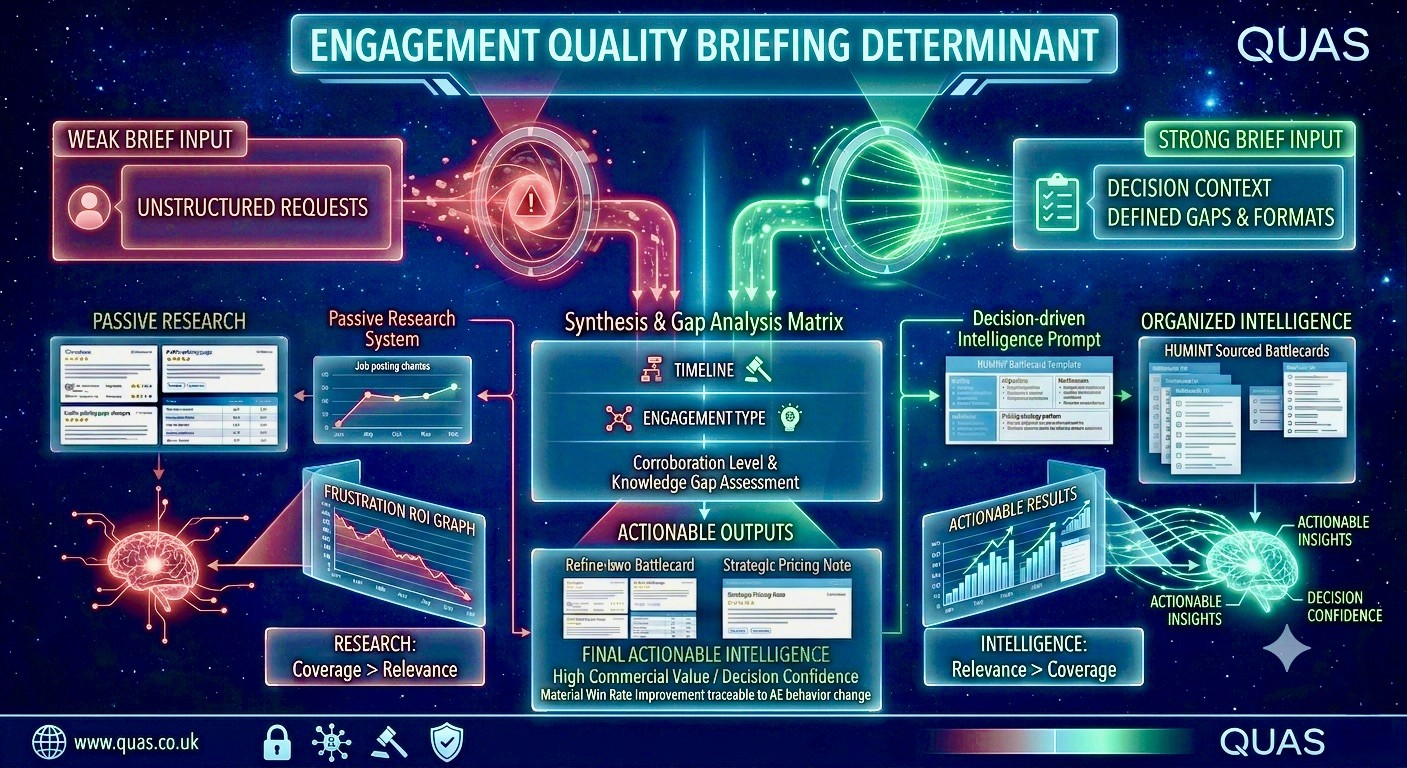
Most competitive intelligence engagements underdeliver. Not because the analyst is weak — because the brief was. The intelligence an agency can produce is bounded by the quality of the questions it is asked to answer. Here is the research on what determines briefing quality — and the exact framework for writing one that produces intelligence you can act on.
There is a well-documented phenomenon in professional services research called the specification problem. It describes the consistent gap between what a client intends to commission and what they actually communicate to the provider — and the compounding cost of that gap as the engagement progresses.¹ In management consulting, legal advisory, and market research, the majority of engagement failures trace back not to execution quality but to brief quality.
Competitive intelligence is no exception. I have received briefs that could be described, charitably, as a competitor name and a deadline. I have also received briefs that defined the decision being made, the intelligence already held, the gaps that mattered most, and the format in which the output needed to be delivered to be actionable. The difference in intelligence quality between these two starting points is not marginal. It is categorical.
Understanding what makes a brief effective — at the level of cognitive and information science — is therefore not a procedural consideration. It is the primary variable that determines whether a CI engagement produces intelligence or produces research. The distinction matters.
Research is not intelligence
Before examining what a strong brief looks like, the distinction between research and intelligence deserves precise definition — because the brief defines which one you will receive.
Research is the systematic gathering and organisation of information about a subject. It answers the question: what is known about Competitor X? It is comprehensive by design. Its value lies in coverage.
Intelligence is the targeted gathering and analysis of information to inform a specific decision. It answers the question: what do I need to know about Competitor X to make this decision correctly? It is selective by design. Its value lies in relevance to the decision context.
RESEARCH CONTEXT
Gilad and Gilad's (1988) foundational work on business intelligence systems distinguished between what they termed an "intelligence system" and an "information system" on precisely this basis — the former is decision-driven and selective; the latter is comprehensive and passive. Their research found that organisations operating information systems in place of intelligence systems consistently reported lower satisfaction with CI outputs, not because more information was worse, but because more information without decision context is harder to act on than targeted intelligence.²
A brief that says “tell me about Competitor X” will produce research. A brief that says “tell me what Competitor X does in late-stage enterprise evaluations against us, and why we keep losing to them at that stage” will produce intelligence. The analyst’s task in the second case is entirely different — and the output is proportionally more valuable.
The six questions a strong brief must answer
Across professional services research and practitioner literature on CI engagement scoping, six questions emerge consistently as the determinants of brief quality. A brief that answers all six gives an intelligence analyst everything needed to design the engagement correctly from day one. A brief that answers fewer than four will require a scoping conversation to fill the gaps — which is time and clarity that could have been invested in fieldwork.
THE QUAS BRIEFING FRAMEWORK
Which competitor or competitors are in scope?
Name them precisely. If you are uncertain which competitors matter most, that uncertainty should be in the brief — it changes the scoping approach. Do not list every competitor in your market. Name the two or three that appear most frequently in competitive situations and cost you the most when you lose.
Weak: “Our main competitors in the market.”
Strong: “Competitor A and Competitor B — they appear in 70% of our late-stage evaluations and we lose to them at a rate we cannot explain.”
What decision will this intelligence inform?
This is the most important question in the brief and the one most consistently left unanswered. Intelligence without a decision context produces research. Name the decision: a commercial strategy review, a specific account pursuit, a pricing model revision, a product roadmap prioritisation. The decision defines what the intelligence needs to resolve.
Weak: “We want to understand our competitive landscape better.”
Strong: “We are pursuing Account X in Q3 and need to understand exactly how Competitor A will compete in the evaluation.”
What do you already know — and what do you believe but cannot confirm?
Sharing existing knowledge prevents duplication of effort and allows the analyst to focus fieldwork on genuine gaps. The distinction between confirmed knowledge and unconfirmed belief is especially important: beliefs that turn out to be wrong are where the highest-value intelligence is often found.
Weak: “We don’t know much about them.”
Strong: “We believe their pricing floor is around £X based on two conversations with prospects, but we can’t confirm it and we don’t know their discount trigger conditions.”
What is the deal or strategic context?
Size of the opportunity, deal stage, buyer profile, timeline to decision, and any known relationship history between the competitor and the account. Context determines which intelligence questions are urgent and which are background. A deal closing in six weeks has different intelligence priorities than a strategic planning cycle with a six-month horizon.
Weak: “It’s a big deal for us.”
Strong: “£400k ARR, 12-month contract, procurement committee of four, decision expected in eight weeks, Competitor A was already in the account before we engaged.”
What format does the output need to take to be actionable?
Intelligence that cannot reach the people who need it in a form they can use has no commercial value regardless of its quality. A VP Sales needs a battlecard. A board needs a strategic briefing document. A product team needs a structured feature and roadmap analysis. Specifying the output format is not a formatting preference — it is a deployment requirement.
Weak: “A report.”
Strong: “A two-page battlecard for our sales team covering objection handles and pricing intelligence, plus a one-page strategic summary for our CRO.”
What is the timeline constraint?
HUMINT engagement timelines are determined by source accessibility, not analyst availability. Primary source elicitation cannot be compressed beyond the time needed to identify, approach, and interview sources who carry the relevant knowledge. A realistic timeline constraint allows the analyst to scope the engagement correctly. An unrealistic one produces shortcuts that reduce intelligence quality.
Weak: “As soon as possible.”
Strong: “We need actionable intelligence on their pricing and demo approach within three weeks — the account review is in week four.”
The weak brief versus the strong brief
The difference between a weak and a strong brief is not volume of information — it is the presence of decision context. Here is the same engagement request expressed both ways.
WEAK BRIEF | STRONG BRIEF |
|---|---|
WHAT WAS SUBMITTED | WHAT WAS SUBMITTED “We are losing late-stage enterprise evaluations to Competitor A at a rate of roughly 40%. We believe it is happening at the pricing conversation but we’re not certain. We need to understand their actual pricing floor, what triggers a concession, and what they say about us in the room. Output: a battlecard for our AEs and a pricing strategy note for our CRO. Timeline: three weeks.” |
WHAT THE ANALYST CAN DESIGN | WHAT THE ANALYST CAN DESIGN A focused HUMINT engagement targeting former sales employees, channel partners with multi-vendor experience, and customers who have been through a competitive evaluation. Specific intelligence questions that the brief defines. Two defined output formats. A clear success criterion. |
LIKELY OUTCOME Research the client could largely have produced internally. Limited actionability. Frustration with ROI. | LIKELY OUTCOME Confirmed or revised pricing intelligence. Objection handles grounded in primary elicitation. A battlecard the sales team uses in the next evaluation. |
“The intelligence an agency can produce is bounded by the quality of the questions it is asked to answer.”
What to expect from a well-scoped HUMINT engagement
A brief that answers the six questions above gives an analyst everything needed to design and execute a focused HUMINT engagement. Understanding what that engagement looks like from the client side — in terms of process, timeline, and deliverable structure — removes the uncertainty that causes organisations to either over-specify (trying to manage the process they cannot see) or under-engage (receiving deliverables they did not know to ask for).
THE ENGAGEMENT TIMELINE
WEEK 1
Scoping and source mapping
Brief refinement conversation to confirm intelligence priorities. Source identification: mapping the human network most likely to carry the intelligence required — former employees, channel partners, shared customers, industry contacts. Source approach strategy agreed with the client where relevant.
WEEKS 2–3
Primary source elicitation
Structured interviews with identified sources using ethical elicitation protocols. Interview findings logged against intelligence questions from the brief. Source corroboration — no single-source intelligence is delivered without verification or explicit caveat. Mid-engagement check-in with client to surface any emerging findings that require direction change.
WEEK 4
Analysis, synthesis, and delivery
Intelligence synthesis against the specific questions in the brief. Battlecard production in the format specified. Strategic briefing note if required. Delivery session — not a document drop, a structured briefing that walks through findings and answers questions from the sales or strategy team who will use the intelligence.
THE DELIVERABLE STRUCTURE
A well-scoped HUMINT engagement produces defined deliverables, not open-ended research. The standard QUAS engagement deliverable set for a focused competitor engagement covers:
✓ Primary intelligence report
Findings from source elicitation, structured against the specific questions in the brief. Source attribution anonymised. Confidence rating for each finding based on corroboration level. No unrequested background research — only what the brief asked for.
✓ HUMINT Battlecard
Two-page, deal-cycle-ready document in the format described in the fourth article in this series. Competitor positioning, pricing intelligence, demo script, three objection handles, known weaknesses, and a recommended counter-strategy for the specific deal stage.
✓ Pricing intelligence note
Where pricing intelligence is a primary objective: a standalone document covering known floor, discount trigger conditions, late-stage concession patterns, and commercial strategy implications. Formatted for review by commercial leadership rather than for field use.
✓ Delivery briefing session
A structured briefing with the sales team, CRO, or strategy team — whoever will act on the intelligence. Not a presentation of the documents but a facilitated session designed to transfer the intelligence into the team’s understanding and generate the questions that the documents should answer in practice.
✓ 30-day follow-up
A structured check-in four weeks after delivery to review how the intelligence performed in the field — which findings proved accurate, which require revision, and what the next intelligence priority is. This is the feedback loop that determines whether the engagement produces a one-time deliverable or the beginning of an ongoing intelligence function.
The difference between a one-off engagement and a retainer
The question of whether to commission a one-off engagement or an ongoing retainer is ultimately a question about the nature of your competitive environment — and how fast it changes.
Research on competitive dynamics by D’Aveni (1994) on hypercompetition established that competitive advantages in fast-moving markets have shorter half-lives than in stable markets — and that organisations that treat intelligence as a periodic rather than continuous function lose competitive position between intelligence cycles.³ In B2B SaaS and Fintech markets — the environments QUAS operates in — competitive behaviour changes at a rate that makes annual intelligence refresh inadequate for organisations competing at high deal velocity.
A one-off engagement is the correct starting point for organisations that have a specific decision to inform, a defined competitive situation, or no existing intelligence function to build from. It produces a point-in-time intelligence snapshot that is highly accurate at delivery and decays in relevance over six to twelve months.
A retainer is the correct structure for organisations where competitive intelligence is a continuous operational requirement — where deal cycles overlap, where multiple competitors require monitoring, and where intelligence needs to flow continuously into a sales team’s preparation rather than arriving in a quarterly document.
Most organisations begin with a one-off engagement and convert to a retainer when the intelligence proves its commercial value in the field. That is the correct sequence. Intelligence should earn its continued investment through demonstrated impact on competitive outcomes — not on the basis of a recurring contract signed before the first engagement has delivered.
What to evaluate when assessing a CI agency
For organisations assessing multiple competitive intelligence providers, the following evaluation criteria — grounded in professional services quality research — identify the variables that predict engagement quality more reliably than pricing or case study volume.
METHODOLOGY TRANSPARENCY
A credible CI agency should be able to describe precisely how it gathers primary intelligence — what source categories it targets, how it conducts elicitation, what ethical protocols govern its fieldwork, and how it handles source corroboration. Vague answers to these questions indicate either a lack of genuine HUMINT capability or an approach that would not withstand scrutiny. Parasuraman, Zeithaml, and Berry’s (1988) SERVQUAL model identifies transparency of process as one of the five primary dimensions of professional services quality.⁴ Ask the question directly.
DECISION ORIENTATION IN THE SCOPING CONVERSATION
The scoping conversation is itself a quality signal. An analyst who asks what decision you are trying to make — before asking what competitor you want research on — is operating with an intelligence mindset rather than a research mindset. The first question reveals the orientation of the entire engagement that will follow.
WILLINGNESS TO DEFINE SCOPE BOUNDARIES
A CI agency that accepts any brief without pushback is not doing its job. Scope that is too broad produces research. Scope that is internally inconsistent produces confusion. A rigorous analyst will challenge an under-specified brief and refine it before agreeing to an engagement — because their professional reputation depends on the quality of what they deliver, and a weak brief makes strong delivery structurally impossible.
EVIDENCE OF SOURCE NETWORK, NOT JUST METHODOLOGY
Methodology without source access produces elegant fieldwork plans that cannot be executed. Ask how the agency will identify and access the human sources that carry the intelligence you need. The answer reveals whether their HUMINT capability is operational or theoretical.
REFERENCES
Turner, J.R. (1999). The Handbook of Project-Based Management. McGraw-Hill. See Chapter 4 on specification quality in professional services procurement.Gilad, B., & Gilad, T. (1988). The Business Intelligence System: A New Tool for Competitive Advantage. AMACOM.D'Aveni, R.A. (1994). Hypercompetition: Managing the Dynamics of Strategic Maneuvering. Free Press.Parasuraman, A., Zeithaml, V.A., & Berry, L.L. (1988). SERVQUAL: A multiple-item scale for measuring consumer perceptions of service quality. Journal of Retailing, 64(1), 12–40.
QUAS Mission
The Price of Being Blindsided.
QUAS exists so our clients never walk into a deal, a negotiation, or a board meeting without knowing exactly what they're up against.


I started QUAS after watching companies make multi-million pound decisions off public information, and nobody was checking if it was true. Most competitors don't go quiet because nothing's happening. They go quiet right before they do something you haven't seen coming.
Eimantas Raziunas
Founder & Director
BA
International Business Management
MSc
Business & Organisational Psychology
Risk Mitigation